
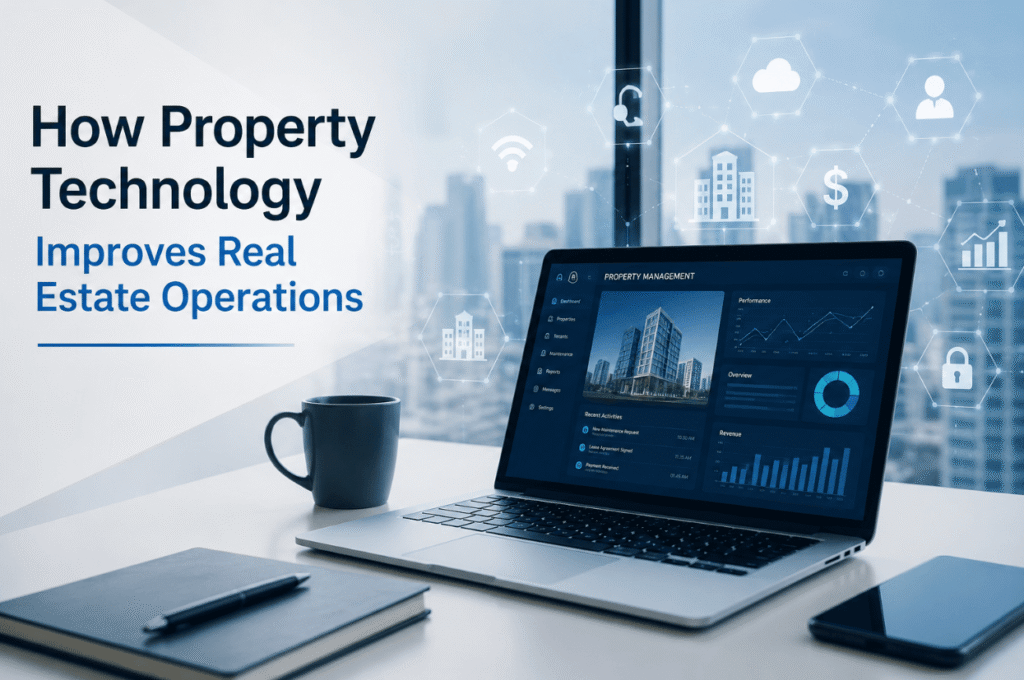
Real estate operations are changing rapidly. Businesses face growing demands every day. Costs continue to rise. Customer expectations are also increasing. Therefore, greater efficiency is being prioritised across the industry.
Property technology is helping businesses meet these challenges. Manual processes are being replaced with digital solutions. As a result, operations become more connected and efficient. Better decisions can also be made using accurate data.
This article explains how property technology improves real estate operations. It also highlights the benefits for developers, property managers, investors, and real estate firms.
Why Real Estate Operations Need Digital Solutions
Traditional processes often create delays. Paper records can be difficult to manage. Separate systems also slow communication.
Consequently, valuable time is lost. Errors are more likely to occur. Operational costs may also increase.
Digital platforms solve many of these issues. Information is stored in one place. Teams can access data quickly. Therefore, daily operations become easier to manage.
Automation Improves Everyday Tasks
Many routine tasks can now be automated. Rent collection is one example. Lease renewals are another. Maintenance requests can also be managed automatically.
As a result, administrative work is reduced. Staff can focus on higher-value activities instead.
Furthermore, automated reminders help prevent missed deadlines. Records also remain accurate across different departments.
Centralised Systems Improve Property Management
Managing multiple properties requires reliable information. However, disconnected systems create unnecessary challenges.
Cloud-based platforms solve this problem. Property data is stored securely in one location. Financial records, maintenance schedules, and tenant information remain connected.
Therefore, managers gain a complete view of their portfolios. Better decisions can be made with greater confidence.
In addition, collaboration improves. Teams can access the same information from different locations.
Data Supports Better Business Decisions
Data plays an important role in modern real estate. Business decisions should be supported by reliable information.
Property technology provides real-time insights. Occupancy rates can be monitored easily. Rental income can also be tracked. Maintenance costs become more visible.
Consequently, performance trends are easier to identify. Potential issues can also be addressed earlier.
Predictive analytics offers additional value. Future demand can be estimated more accurately. Budget planning also becomes more effective.
Smart Buildings Increase Operational Efficiency
Smart building technology is becoming more common. Connected devices monitor building performance continuously.
Lighting systems can be controlled automatically. Energy usage can also be measured. Security systems remain connected at all times.
As a result, resources are used more efficiently. Operating costs can also be reduced.
Predictive maintenance offers another advantage. Equipment problems are detected before major failures occur. Therefore, repairs become less expensive and less disruptive.
Better Experiences for Tenants and Clients
Property technology improves communication. Digital portals simplify everyday interactions.
Tenants can submit maintenance requests online. Payment records are also available instantly. Important documents can be accessed at any time.
Consequently, service becomes faster and more transparent.
Investors also benefit. Operational reports can be shared quickly. Portfolio performance becomes easier to evaluate.
Stronger Security and Compliance
Large amounts of sensitive information are managed every day. Therefore, secure systems are essential.
Modern property technology includes advanced security features. User access can be controlled carefully. Data is also protected through encryption.
In addition, digital records support compliance. Important documents remain organised and accessible whenever needed.
Lower Operating Costs
Operational efficiency often leads to lower costs. Repetitive tasks require less manual effort. Paper-based processes are also reduced.
Furthermore, predictive maintenance helps prevent expensive repairs. Energy management systems lower utility costs. Resource planning also becomes more effective.
Although implementation requires investment, long-term savings are often achieved.
Preparing for the Future
Technology continues to evolve. Artificial intelligence is becoming more capable. IoT devices are also expanding across commercial properties.
Therefore, digital transformation should be viewed as an ongoing strategy. Businesses that invest early are often better prepared for future changes.
Modern operations require flexible systems. They also require accurate data and connected workflows.
Conclusion
Property technology is transforming real estate operations. Everyday tasks are being automated. Business data is becoming more accessible. Smart buildings are also improving operational performance.
As digital adoption continues, greater efficiency will be expected across the industry. Therefore, investing in property technology can help businesses improve productivity, reduce costs, and strengthen long-term competitiveness.
